Reinforcing Concrete with FRP wraps in Historical San Francisco Building
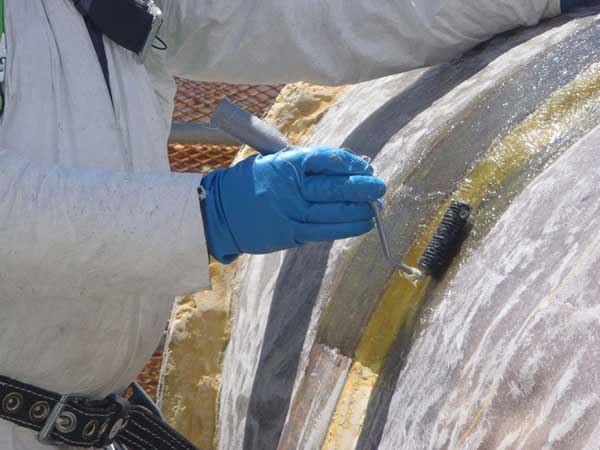
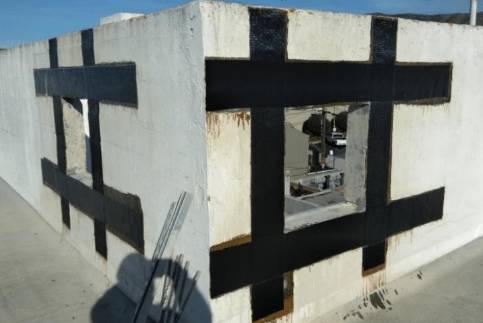
Here we look at a San Francisco historical building currently occupied by a restaurant that required reinforcement for some old concrete sections. Read more »
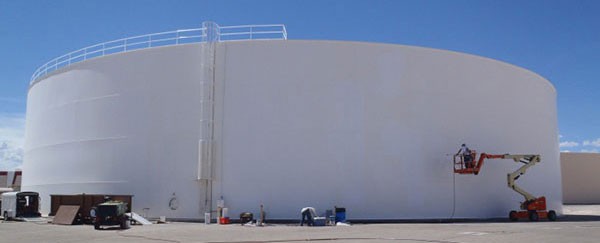
An adequate public water supply necessary for fire suppression is not always available, and in such cases a firewater tank can be used to aid in the suppression of fires which break out in either a residential or commercial setting. The tank sizing for such a firewater tank is important, because if it cannot meet the needs of fire suppression, the fire will not be contained, and it is likely that one or more buildings will be severely damaged as a result. Commercial firewater tanks in the Bay Area, as in other sections of the country, are generally sized according to a specific calculation which ensures there is sufficient water and water pressure to do the job. Read more »
![]()
Fire water tanks and the sprinkler systems they feed may not be the most visible elements of a structure, but they are absolutely essential for keeping people safe in the event of a fire. In fact, the National Fire Protection Association (NFPA) has outlined strict requirements for tank inspections, with the goal of making sure that tanks remain able to supply water during an emergency. Read more »
Industries, construction sites, hospitals, and other commercial properties are vulnerable to fires unless the proper steps are taken to ensure safety. For this reason, businesses are increasingly looking into the installation of firewater storage tanks in the Bay Area not only as necessary precautions, but also to comply with government regulations. Here are some of the benefits of installing firewater storage tanks and a look at the types of tanks available for commercial properties. Read more »
Image via Unsplash
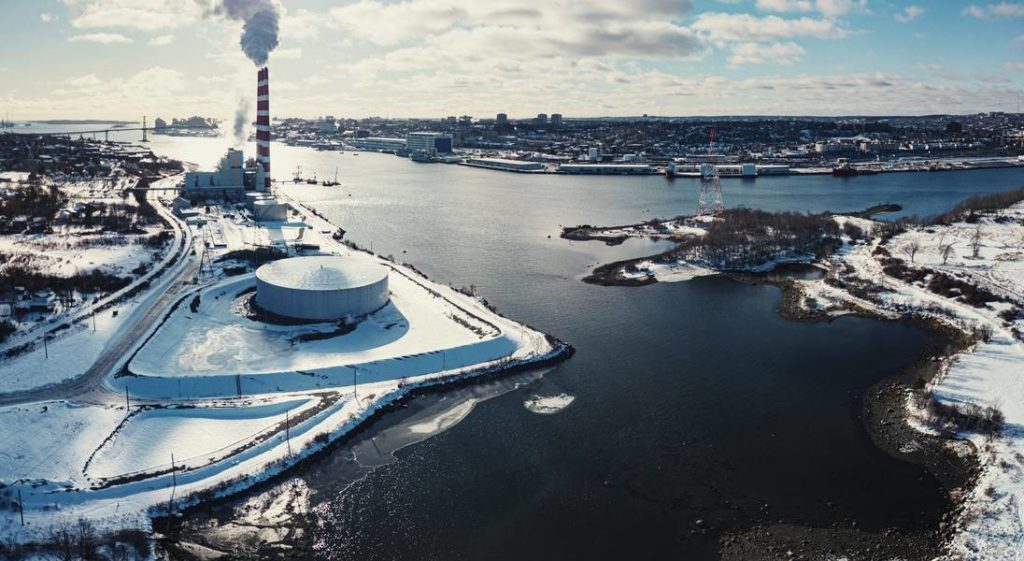
There is a unique feature of the building at One Rincon Hill in the city of San Francisco, which is its Bay Area firewater tank, situated atop the high-rise building. Although it’s not the largest building in that city, One Rincon is definitely the tallest building outside the main business district, and it can easily be seen against the skyline, with its rounded cylindrical top. This building stands nearly 700 feet above San Francisco Bay, and it contains a feature that makes this high-rise tower very unique, the water tank which holds 50,000 gallons. Read more »
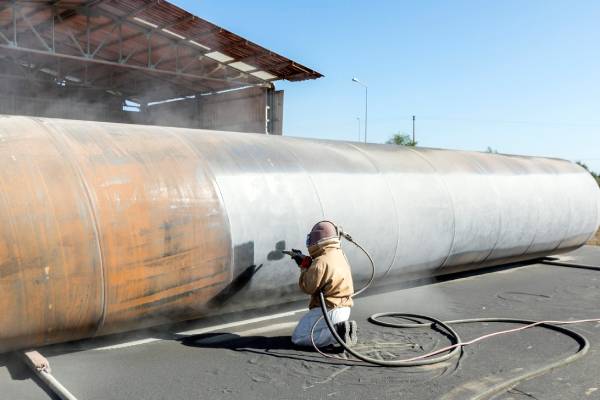
Removing an old lining on stainless steel require specialty abrasives due to the hardness of stainless steel. It is very critical to measure the surface profile and we do a battery of tests using ASTM and NACE standards to test the profile of the blasted surface before a new tank lining or tank coating is applied.
A customer in Los Gatos, CA required tank lining repairs fora Aqua Ammonia tank which was used to store max 19% aqueous ammonia. Chemical storage tank and manway cover before repairs are pictured below.
![]()
![]()
![]()
70,000 gal each x 3 tanks
Diameter = 14 feet, Length ~ 70 ft
Sodium Hypochlorite
San Francisco Bay Area, CA Read more »
![]()
A reliable, durable and long-lasting tank coating relies upon expert prep work. Whether your liquid storage tank linings are installed in the field after purchase, or needs a new lining prior to re-purposing the tank, careful preparation is key to protect your equipment investment. The old coating (and/or any initial corrosion) must be removed thoroughly and completely to Near White Cleanliness or White Metal Blast level, to provide a proper surface for the application of new tank linings. With proper interior and exterior tank coatings, plus timely water tank repair and maintenance from your experienced coatings contractor in the Bay Area, your storage tanks (and corrosion resistant tank linings) will provide many years of reliable service for your business. Read more »
![]()
Fiber-reinforced composites for tank linings are gaining widespread popularity these days, as more and more people discover their inherent strength, resistance to corrosion, and tolerance of high temperatures. New composites are being developed which increase the already considerable beneficial properties offered by fiber-reinforced plastics (FRP), and similar composites. As a result, these materials are beginning to be used in a number of applications which were once dominated by metals and alloys, especially since the fiber-reinforced tank repair products tend to be considerably less expensive than metals are.
There is a high demand globally for products which are extremely tough and able to withstand severe weather, as well as providing a great deal of strength. The same applications frequently call for materials which are highly resistant to corrosion, because normal weathering can cause corrosion, and because corrosive materials are being stored, for instance various types of chemicals tanks.
There are also many cases where products are called for which have a tremendous tolerance for high temperatures, because of conditions which they are exposed to. Fiber-reinforced products manage to provide all these characteristics at a very high level, and have already been shown to perform well in applications, such as concrete strengthening and tank liner repairs, where they’ve been used. Perhaps best of all, these highly desirable characteristics can be obtained in products which are far less expensive than the metal-based products which have been most often used, up to this point.
With considerable research and development leading to the creation of some ultra-strong, highly resistant composites such as composite/concrete, a number of bridges have been constructed in the states of Maine, Illinois, and New Jersey which have taken advantage of these new materials. Opportunities have arisen for the fabrication of pre-manufactured stay-in-place (SIP) forms which might formerly have been satisfied by concrete strengthening solutions. The rehabilitation of steel culverts in some areas has been accomplished by the usage of composite liners, which replace culverts degraded by rust, corrosion, and a general weakening of structures.
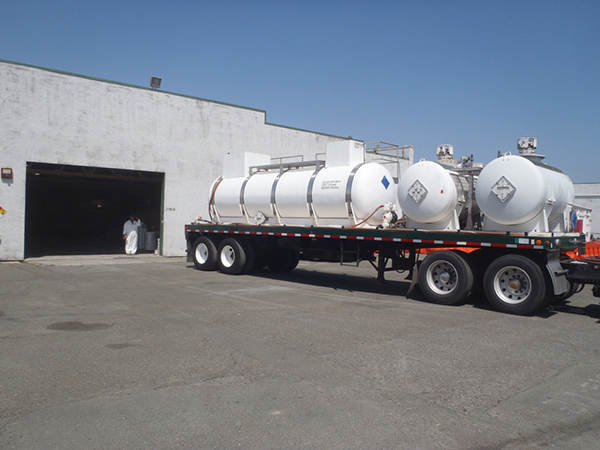
Another very strong market for fiber-reinforced materials is in the area of ducts, piping, and tanks which contain highly corrosive chemicals and other substances. Although this market has been dominated by metal-based products in the past, fiber-reinforced products are beginning to make inroads into the market, as its effectiveness and relatively cheaper cost becomes more widely recognized. This can be particularly useful in specific applications such as bleach transport, which is currently done largely via railway cars. A very viable alternative is emerging in which high-concentration bleach is shipped via FRP-lined cargo trucks which are safer for the environment, and cause less disruption in cities they pass through.
Given the fact that FRP-based products have already proven to provide superior performance, even under some very stressful conditions, and that they are cheaper to use than metal-based products, it seems apparent that the future for FRP-based products is rosy indeed. Further research and development will undoubtedly discover even more capable products, and as these are put to use, a powerful new alternative to metal-based products will gain greater acceptance.
You must be logged in to post a comment.